Tuesday, May 6, 2014

5/5/14 Travel day to Melbourne, Victoria

IPads at every seat on Qantas!
Coming into Melbourne
Not a great deal happened Monday.  We had a bit of free time in the morning to work on the final report we are doing on this trip and then went to Coffs Harbour airport to head to Melbourne, Victoria ending our time in New South Wales.  Had a nice flight but got into Melbourne and to our hotel just in time for dinner and bed so nothing to write about.  We will be in Victory until the 9th I think when we will fly to Tasmania.

Each evening we have had the opportunity to carry on the days work by chatting with various local fire agency people who come by to join us for dinner.  It's nice but makes for a very long day!

As I write, Tuesday is over and we had a very, very long day which I hope to write about in the morning because I am to tired now.  I will say we are not starving on this trip, in fact, we get so many meals its painful but we are doing our best!  We had tea at a winery today to learn about "grape taint" which is
Tea at Oakridge Vineyard
when the grapes are impacted by smoke.  Wineries are very big here in the Yarra Valley.  Tea was wonderful but the 5th meal since 7 am!!

Nice bus picked us up
in Melbourne!
So I'm curious if anyone is reading this.  Any comments?  Any questions we can ask down here?  Got some very interesting info on their risk management program today which I will try to explain tommorrow.

Time to go eat again!!! Love to hear some comments or questions.

Sunday, May 4, 2014

5/4/14 Ngunya Jargoon IPA - Bungawalbin - Whiporie Plantation - Coffs Harbour


The tour group listens as Mark with
HotSpots, shows them Borona Pinnata
The tour group spent a fascinating Sunday getting to know more about the aboriginal culture from its "song lines" and stories, to the way their cultural values relate to fire on the landscape.  We began the day just south of Ballina in one of 4 North Eastern NSW Indigenous Protection Areas (IPA) - this one is called Ngunya Jargoon. Ngunya means "my" or "our" and Jargoon means "land."  The IPA is a conservation area that holds a huge variety of flora and fauna.  There are 62 species of orchid that grow 
and are protected here. We were shown a flowering plant called Boronia Pinnata with a pleasant, strong smelling oil, one of many plants being conserved here for its medicinal uses.  The IPA is being studied and conserved for bioprospecting, that is, looking for valuable industrial & medical chemicals and oils in its native plants.  

We were met by Oliver Costello with the Northern Rivers Fire and Biodiversity Consortium, a network of
 land managers and stakeholders working toward a landscape approach to fire and biodiversity in Northeastern New South Wales. Oliver's talk with us focused very much on the success of this IPA in building a fire management plan that was geared toward and around respect for the historic and cultural use of the land by inclusion of the aboriginal land owners, the Jali Council of the Bundjalung Nation. 
Tour group members getting
 Lemon Myrtle tea
We were met, when we arrived, with a fire over which he was making tea, made from leaves of the Lemon Myrtle tree - very good, very lemony and refreshing! 

As has happened almost every stop where we were outside looking at landscapes, the land manager hosting us begins his or her talk by asking us to recognize and honor the original owners of the land, the custodians who have cared for it for  thousands of years making it possible for us to appreciate it today.  A very interesting cultural nod!

The consortium program in place here is called the Firesticks Project which aims to reinvigorate the use of cultural burning by working closely with aboriginal communities to build trust, and thereby buy in and understanding, about the need to put fire on the land in historically appropriate ways that support the complex biodiversity of the land. Oliver says it was not a quick process.  Building the trust with the aboriginal community required time and a willingness to meet, talk and share, as well as set aside some past history, to get to a place where they could begin working together. The Firesticks approach takes into consideration not just the land but the culture of the people that live there.  

The fire management plan has a very strong connection to history.  Oliver talked about that connection all the way back to "the dreaming" which is essentially the Creation for the Aboriginal people. They had a "corroboree," similar to a pow wow among Native Americans in the US, where elders and land managers talked about the history of fire on the land and how it was used to open up pathways
Oliver Costello talks about the IPA
 used by many original people to travel "in country." Those pathways also served as firebreaks and fire scars are where "bush tucker," or aboriginal food grows. He said it's time consuming but the collaboration with the elders was a critical part of making the planning process work.  He says it has to be about more than just the paper that gets signed or it will disappear when specific elders or land managers move on.

There are several conservation areas in Northeastern New South Wales and the research and planning done in each will be used to help the government build better land management practices and research elsewhere. Once the work done in these IPAs is done, the traditional custodians of the land will be a part of communicating that research.  Its also hopes it will help them learn more about their own land and reconnect them to the land and their history.
Mathew Pope -
Forest Corporation

A short bus ride later we were in Whiporie at another pine plantation, this time with a southern pine species.  We heard from Mathew Pope about the challenges of fighting fire where the only have 10 staff members and arson can be a problem! There is also the issue of the local people burning grass to get it to have "green peaks" so its better for grazing, but then once its started burning, simply walking away. Those fire get away a lot and threaten the pine plantations.  SO much time is spent working with neighbors and the community so they recognize the pine as an asset.  For Matthew, all firefighting is inital attack and they use only heavy equipment - dozers and aircraft - to manage it, no hand line at all.   He says 90% of their fire is from re-ignition of purposely started fires. 
Big Dingo!

Following our time at the plantation  we headed back to Coffs Harbour. Along the way we found another "big thing!"  this was a giant Dingo, the native wild dog found all over the Australian Outback! And yes, it has something in its mouth but not a baby (if you've seen the movie!). It was a stuffed Christmas elf for some reason!

We were lucky enough to be done with our day about 3:45 and have some time to walk to the beach areas of Coffs Harbour and dip our toes into the ocean!  The evening ended with dinner down on the Jetty.

Toes in the ocean at Coffs Harbour
Mondays schedule involves working on some of our final report in the morning and heading to the airport to head for Melbourne and the Victoria part of our trip.

Saturday, May 3, 2014

5/3/14 Symposium in Canberra - Coffs Harbour - Ballina

Very busy few days, hence missing one post. I am writing on Saturday. WIFI is scarce so adding pictures is difficult.

Friday was an all day event, the final day of the 6 nation, International Symposium on Bushfire Management.  We had some amazing speakers all day which I will not try to summarize but try, instead to generalize. There were 5 sessions in the symposium, including Tom Harbour Thursday, and 4 on Friday. The intent was after each presentation, the facilitator would distill the issues raised,  down to three subject areas and all participants broke into groups to discuss a subject area.  We listened to Jean-Michel Dumaz from France talk about ICS, HROs and other human factors related to a safety culture.  We listened to Professor Jim McLennan from Trobe University in Melbourne talk about his research about Information Flow and messaging.  Dr McLennan has worked a great deal with Sarah MacCaffrey whom many in the US know from her fire research.  We heard from Andrew Sullivan on how we determine the research priorities of practitioners and from Jean Michel Dumaz again  about some of the newest research being done for fire related tools and equipment in France. And lastly, the group took all the discussion, learning, and short and long term goals of the group and distilled them into priority projects for all 6 nations and devised a plan for follow-up.


A long day but, very satisfying to see the many similarities and few differences between all countries and the willingness to work toward solutions that provide answers for all.  We finished the day with a final BBQ put on by our ACT hosts at the Stromlo Fire Depot.    Had some yummy "snags"  kind of a hot dog looking thing but tasted way better.  And some very thin steaks, also delish, and lots of other goodies. It was a great way to say goodbye to friends from the ACT.

The "big" banana in Coffs Harbour!
Saturday began very early as we caught a 5 am bus to the airport in Canberra for a flight to Sydney and to Coffs Harbour. Coffs Harbour is a beautiful area north of Sydney which makes it nearer the equator and much warmer and more tropical.  There were palm trees at the airport and the air was significantly warmer and more humid.  Our first stop was "the big banana" the second in our tour of "big things" in Australia.  The first was a "big fish!"  I cannot explain this!  Coffs Harbour is home to many banana plantations that produce smaller and tastier bananas that we buy in the states.  They also have huge blueberry production, much of which goes to the US.

We were met in Coffs Harbour by Adrian, our escort for the north east part of New South Wales, and some of the Rural Fire Service people he works with.  We spent the day learning about the community fire protection programs in use in the area that mesh risk reduction programs with biodiversity and the historical knowledge and burning practices
 of the aboriginal people of the area. 
Overlook at Coffs Harbour
We went to a turnout that overlooks the ocean off the east coast of Australia.  It looks a lot like the coast of San Diego. Like San Diego, most of the population lives near the beach in small communities and its difficult to do prescribed burning.  But they do burn in small patches as they can, trying to return the area to its original grass ecosystem.


We were introduced to 3 people, John, Waminda and Mark, that were part of a program called Hot Spots.
Jamie, left with Rural Fire Services and
 John with Hot Spots talk about their programs
Add caption
Jamie shows the tour group a prescribed burn
done by the aboriginal owners of some land
near Red Rock River.
 It is a collaborative effort between state, local and other land management agencies to help communities with landscape restoration and community collaboration. While there are Community Bushfire Protection  programs done by the Rural Fire Service to help homeowners and "shires" build "Asset Protection Zones" in their community, RFS works mostly in larger communities. Hot Spot works in rural areas where there are larger holdings and communities are chosen by 3 criteria:  They must be at high risk from bushfire, they have to have high biodiversity value, and they must be a cohesive community that is receptive to what Hot Spot wants to do.  What's fascinating is the Hot Spot personnel meet with the community, assess property Asset Protection Zones even providing landowners with specific, closeup maps of their property.  On these maps, the land owners identify the assets on their property, the biodiversity values on their land and define the role they would like fire to play on their property.  Hot Spot will also help landowners remove hazard materials and teach them to do their own prescribed burning to maintain their property. It's very much a "teach them to fish" model in which the Hot Spots teach and the communities learn and have passed a long, even generationally, what they have learned. Hot Spots also research and talk to the aboriginal people still available who hold the history of fire on aboriginal lands and pass along past burning .

Red Rock River, an aboriginal holding.


If there is one thing the Australians have done very well, among many things, it's collaboration and building relationships.  And not just with agency partners but with the people in their communities as well, making them full partners in the process of protecting their property from fire and even maintaining the correct ecological balance.


Thursday, May 1, 2014

5/2/14 Jindabyne - Parks Office - Canberra

Another day of exploration and discovery!  And hurrying!  We began the day at breakfast in a bakery near our hotel in Jindabyne.  They are big on meat pies here - they all look like small pot pies. And there was quiche, so some people had egg based pies.  I had a meat pie which was pretty good.  Odd for breakfast but good!  Then of course, since it was a bakery, we had pastries.  Our driver Mick refers to them as "naughty bits" which we thought was hysterical!  And the coffee, well, we finally got the hang of it.  The main orders are "flat white" and "long black."  Flat white is coffee with milk (there doesn't seem to be any cream used EVER for coffee) and long black is like an Americano.  Mostly loving the long black!  We have many photos and are trying to add to them. Take a look at the Dropbox link to the right.  May be duplicates, may be poor shot,s but I'll sort & delete when I have time.

So let's see, back to business.  After breakfast went to a Parks Office to learn more about Kosciuszko State Park.  Learned about the history of the place, how its structured and the role fire plays.  I don't have many details as I lost all my notes for some reason. But I do remember that the main point was the collaboration between the 3 states that border around the park: New South Wales, Victoria and the ACT. They meet regularly to talk about fire management, especially the sharing of resources and willingness to help each other on an informal basis. There are formal agreements at the state level, but local collaboration is informal. They have agreements in place allowing them to chase a fire 15 or so kilometers across the border without even calling to say they are there.  But they also help without worrying about funding.  Is not unusual for one state to fight a fire across the border that they picked up, or that the owner state is too busy to deal with.  So they fight the fire and pay for it without worrying about being repaid.  Ian Dicker says its about good will and good relationships.

Funny quote of the day, as we are finding many!  Ian referred to something that rarely happens as "Rarer than rocking horse poo!"  Now that's rare!

The drip torch on the front of the Green Dragon
Saw some "toys" used by the firefighters here in the park.  There was the Green Dragon, something also used in Florida.  An all terrain vehicle with a drip torch at the front and I think a CO2 tank at the back.  They use two people, one to drive and one to fire.


They also had what they called the blow drier seen below!
The "Blow Dryer!"
It's a truck with a platform on the back that has a large engine and a nozzle/tube maybe 6 or 8 feet long, about 12 inches across and curved.  The nozzle can rotate in any direction. When the fuels are damp or wet and they can't get a burn going, they drive along and blown on it to get it going!  Sounds like a jet engine but is apparently pretty effective!  The study group was loving it and quite envious.

Then it was back on the bus for a long drive back to Canberra where we were invited to participate in the first International Symposium on Bushfire.  Six countries represented by high level people (some ambassadors and Commonwealth Senators) involved in their nation's fire response and fire policy: Canada, Mexico, America, New Zealand, Australia and France.
Tom Harbour on far right.
Tom Harbour, Forest Service Director of Fire and Aviation (seen in picture to the left) spoke first and talked about what he saw as challenges in our future: the increased connectedness and therefore expectations of the world,  the increase in size and complexity of all fires, the paradox of a public that is feeling generally safe because we are good at what we do but that maybe aren't as safe as they feel and, maybe most importantly, the distance of most people from the natural ecosystems around them.  Many don't know where their food comes from or where water originates.
Our host Neil Cooper
addresses the symposium
In fact, he suggested that perhaps worldwide concern about the future of our water supply might be a way to connect people to an ecosystem that is important to them and thereby, to the place of fire in that ecosystem.  Harbour was followed by a French researcher talking about the Wildland Urban Interface in France.
Fascinating afternoon with more to come today.

The Symposium was followed by a very nice reception where we were able to celebrate the retirement of Gary Morgan, an Aussie who has been a long time friend of the cooperative sharing of learning between the US and Australia.  Tom Harbour gave him a chrome Pulaski.  Nice evening and we are ready for more today.

Wednesday, April 30, 2014

5/1/14 RFD - Kosciuszko State Park - Black Perry -Yarrangobilly caves

Spent the morning in Tumut learning about the Rural Fire Service, the primarily volunteer fire brigades responsible for most bushfire firefighting in New South Wales.  There are about 70,000 volunteers across NSW, according to Ian Stewart, District Manager for the Riverine Highlands, with about 1700 on the books in his area. Managing a large group of volunteers is challenging and there are about 700 available at any given time to go immediately to a fire if needed.  

Ian Stewart, RFS, talks with Juan from Mexico
Stewart said they are facing new challenges with the volunteer corp that is traditionally drawn from farmers in a community that are willing on help on fires when it is their land that is threatened.  However, the numbers of family farms are dwindling, the farmers are an average of mid 50's and the next generation of children is moving to urban areas for work. They are working to bring firefighting into high schools to try and get younger people interested and adopting a more flexible plan - people can move in an out of a fire brigade throughout their lives as they wish.

The RFS supports volunteers with several levels of training depending on how much training they want to take and where they work.  And safety of fire crews has become a priority after the Black Saturday fires in 2009. Stewart says now the approach looks at danger to firefighters before actually worrying about putting the fires out. That was not true prior to the fires in 2009. They do talk about risk assessment but don't have any formal procedure for doing that kind of assessment.

Blowering Lake - there are Emus there by the lake!
Funding was a very interesting concept.  The RFS is funding about 11% from local government, another 12 or so percent from state government, but 70% of the funding comes from the Insurance Council.  Also interesting, Stewart says they have reactive and proactive fire fighting.  Reactive is responding to a call to help.  Proactive is when he goes into a community he talks about shared responsibility.  Like in the states, people call the fire department and expect that they will come with a truck and put it out. Stewart tells them "well I have expectations as well that YOU will take steps to protect your own property."  They do have laws supporting that but its still in process.


Park scenery
A huge thing was called ICON. This is a web-based system for reporting all fire information - every call, every response, everything.  And its all public instantly.  Stewart says before he does anything else in responding to a fire he is required to put the information on ICON which ensures that all the public knows, and more importantly all the government and higher ups know the moment a response is happening. The idea is they don't wait till they have all the information and do a more formal statement about it.  Its more like every dispatch call is out there publicly right away.  ICON and everyone who works on it, which can be upwards of 150 people, is based in Sydney.  Their job is to assess all the public conversation via social media and what people are saying with what is coming across ICON and manage all that. Fascinating.


Charlie at Blowering Nursery
Went to Blowering Nursery as well.  Some 8000 to 10,000 seedlings a year produced here.  This is Charlie, one of the Foresters with the Forest Corporation.  Not exactly sure about Forest Corporation but its a quasi public private venture for managing the pine plantations. 

Blowering Nursery is within Kosciuszko State Park which is huge.  After the nursery we went to Black Perry lookout which looks over an area of the Park which is designated wilderness.  

Ranger Matt White 
Matt White the Ranger who met us there described their definition of "wilderness" as a place where you can't do anything fun at all!  No motorcycles, no 4 wheelers, no camping, nothing fun at all!   He was showing us a prescribed fire he had completed a short time ago and talked about balancing the aboriginal history of the place and the biodiversity needs which complicate such burning. 
 There is a rock here called Black Perry which was formed 
The view from Black Perry Lookout
from Limestone and lava and that process produced gemstones.  In this case, garnets and another stone I can't remember. But there is only one other place in the world where that stone is found so he also had to protect this big rock.  It was beautiful but quite foliage dense.  This is an area where the aboriginal people used to migrate to gather these giant moths that they ate.  Still protected for that reason as well as many others.


Picnic at a public campsite
We finally saw a lot of kangaroos and Emus today!  Tons of them up in a sort of high alpine looking area around Blowering Lake.  I couldn't get pictures with my phone but others did and I'll post them later.  Then we stopped at a public camping area to have some lunch. They've provided a nice picnic each day. 

Then we went on to Yarrangobilly Caves. We didn't get to go in the caves but Ian Dicker, at the right here,  talked about the difficulty of protecting the millions of summer visitors in an area should a fire occur. He is standing in front of the Cave House which they are renovating for visitors.  He says they used to think they could put people in the caves to protect them from fires, but discovered the large opening combined with the exit hole and a slight upward slope made for a nice funnel for heat and smoke! So they have a new plan and have done a lot of defensible space work.


Ed Hiatt
The rest of the day was spent driving in the mountains looking at various of burn scars and regenerated foliage.  The Eucalypse prove very challenging for fire control.  One of the main higher elevation species, the ribbon gum, has the very stringy hanging bark that we all recognize as a eucalyptus tree.  But the problem is that the strips curl and make these 6 or 7 foot long tubes that are easily filled with air and lifted.  Its not usual for them to fly, carrying fire, for several kilometers. Ian said one hit his helicopter windshield!

Left is Ed Hiatt from our group holding one of the long curled ribbons from the ribbon gum tree and to the right, others of the group looking at the fuels.  Pretty dense on the ground as well as hanging from the trees.


Standing dead Alpine Ash from 2003
We moved on heading toward Jindabyne where we spent last night and came across an area that was killed in the 2003 fires. The standing dead trees at left are Alpine Ash.  It's a significant fire issue because they need to protect the new trees growing underneath from any new fires as they need 25 to 30 years to produce seeds.  But the standing dead are a significant snag hazard for firefighters as you can imagine. So fighting fire there is a complicated decision about what trumps what.

So that's some of the day.  Off to another presentation this morning, Thursday, followed by the beginning of the International Symposium on Bushfire back in Canberra, and a formal reception late this afternoon so we gotta get our "smart casual" duds on.  That's semi-formal apparently!


Tuesday, April 29, 2014

4/30/14 ACT - Stromlo - Brindabellas - Tumut

An amazingly packed day yesterday. Still catching up on the change in time. Its why I'm writing this at 4 am instead of last night!

Stromlo Fire Depot in Canberra
 Learned a great deal about fire in the ACT yesterday.  Should explain ACT stands for Australian Capitol Territory. Is a long sliver of land, excised out of New South Wales, sort of like the District of Columbia is inside of, but separate from, Washington.  It's the seat of government for NSW and where all the embassies and Parliament and national museums and such are. All the land is owned by the government - private people can lease land for up to 99 years but don't own it - and the ACT has its own Forest Fire agency. ACT has about 400,000 people. ACT Parks manages 73% of the land and there is high urban interface because most of the people live within 30 min of ACT lands
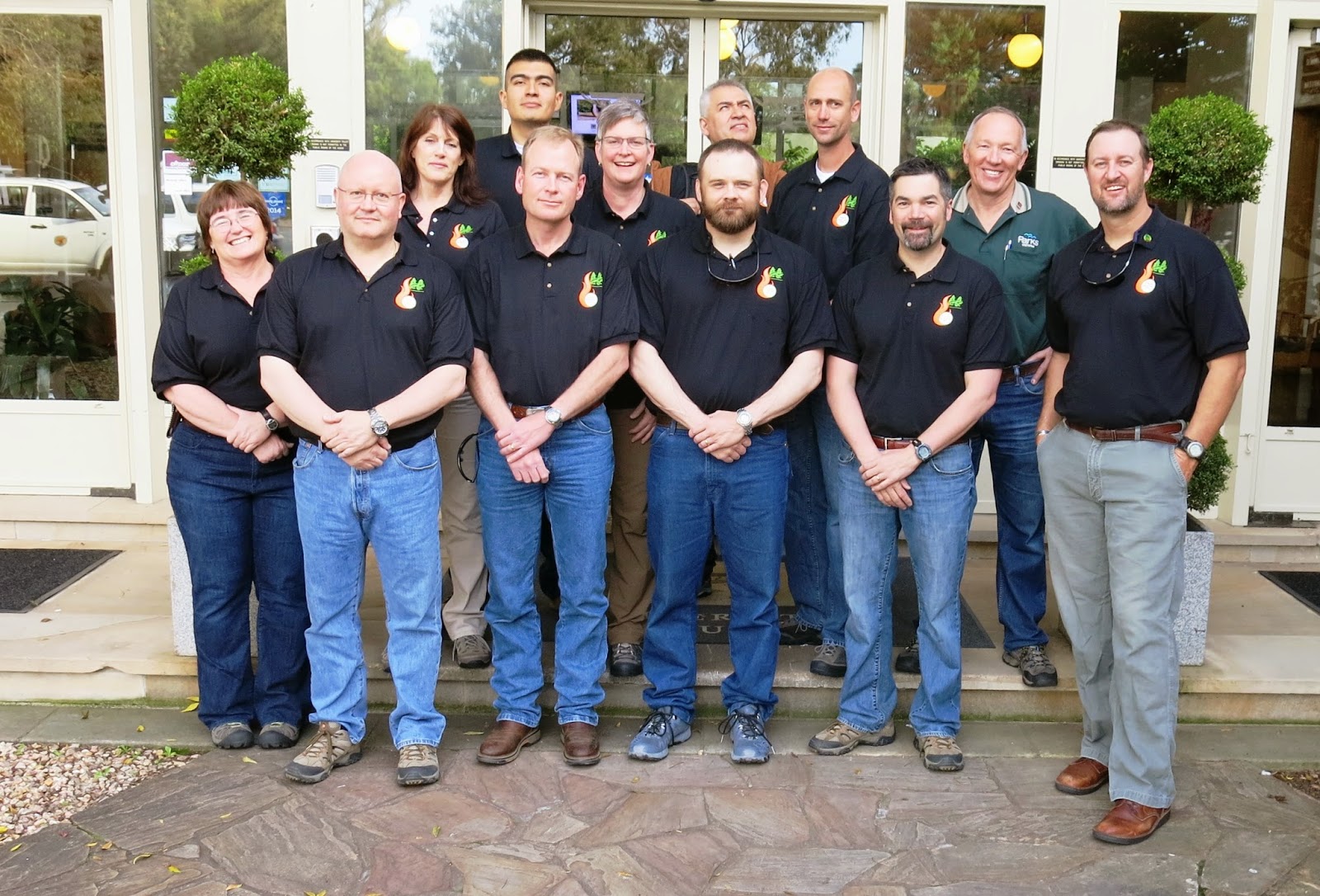
Study group in Canberra
In 2003, 70% of the ACT burned in a giant fire when 4 smaller fires burned together and our visit yesterday focused on what happened,what they learned and what changed after that fire.  Before 2003, the ACT spent maybe $40,000 a year on fire.  Didn't pay much attention, didn't do much to prepare or even worry about it. Much has changed now - millions are spent on preparedness and planning.

You do have to understand that while ACT parks is the fire manager for the land, the rely on the Rural Fire Department volunteers to actually do fire supression.  Reminds me a bit of Texas with the reliance on the volunteers.  And there are the same concerns we have, are the volunteer fire brigades as well trained as they should be?  One of the rural fire brigades is an ACT group so they are involved in suppression but mostly they are the land manager.  And then it is Fire and Rescue that provides structure protection, but not usually under Unified Command.  Its more like, the IMT has a place for ever agency that needs to play but just as a member of the IMT. Anyway, a lot more about that but there were some interesting things learned in 2003.

Their challenges should sound familiar: climate change; balancing urban development with biodiversity and fire; fire protection balanced with ecosystem management; indigenous engagement and managing water catchments or watersheds.  Ever heard that before?!

ACT Parks Fire Planner Dylan Kendall spelled out the changes they have made.  Rather complicated but basically they are doing more strategic planning.  They have a Strategic Bushfire Management Plan (SBMP) and  all other plans must be managed in accordance with the SBMP. It has many parts: Objectives, preparedness, response, community action plans and government action plans.  Under the SBMP, they have a Bushfire Operations Plan (BOP) that is done annually, last one financial year and allocates money and resources to complete actions in a given year.  There are problems - it only looks out a year and does look at how one year relates to another. So they introduced a Regional Fire Plan which looks out 10 years, are map based, are landscape in scale and put all the BOPs in context.

Interesting facts I thought.  They maintain helipads/spots at all times.  They decided how far people could walk (1500 km) and they build helipads all over within that distance for use taking things in or out and they are maintained at all times.  So during a fire they don't have to build them.

They have very creative ways to manage the balance/conflict between fire management and biodiversity and they worked out a graph to decide the rules about managing biodiversity and burning, and when they would bend the rules or how they would do a trade off. Like us they had a lot of pressure after 2003 to do prescribed burning so show the community they were protecting them, but at the same time, everything had burned and they needed to "not burn" to let the vegetation regenerate. Caused a lot of debate about what trumps what.

They have the same smoke issues we do - some under stand the need, some don't.  Everyone hates the smoke.

The public is consulted about the strategic and regional fire plans but not the BOPs.  They value and use local knowledge but want to remain out of the day to day debate,s so this works.

Amazingly, they have passed laws regarding urban design standards and construction.  It's the law if you build in the WUI you must use certain material and designs that meet fire standards. And developers of subdivisions have laws about how they design urban areas in fire prone areas.

And they are increasing "urban resilience" meaning they teach communities to take care of themselves and defend their own property because they recognize they cannot be at every house.  They also provide the equipment and training to help communities do that.

Lastly,  the greatest thing since sliced bread!  They took a look at the IAP and thought about what firefighters REALLY did with it.  Usually grabbed the map they needed, scribbled the DIVS phone number and radio frequencies on it and took that one page and put it in their pocket!  So they made a one page IAP! It has all the critical info and that's what the crews get.

After spending our morning at Stromlo Fire Depot to hear about the CAT we drove up past some prescribed burns and learned about vegetation here.  Mostly Eucalpyse varieties.  Ribbon Gum, Snow gum and peppermint trees, some of the 500 varieties of Eucalypse.  Had lunch on top of a mountain near an old fire and learned about that fire.  Saw a wallabye and some wombat holes!  Drove way up high to a fire tower and met Charlie who told us about pine plantations that are managed by the ACT.  They are government plantations.  And then down to the community of Tumut where we spent the night.

Today, Wednesday, we are headed up in elevation again.  Not exactly sure where but we may encounter snow!!  Meeting amazing people and having quite the adventure.


Monday, April 28, 2014

4/29/14 Bus tour of Brindabellas

We had a lovely morning at the Stromlo Fire depot and learned a great deal about how the Australian Capitol Territory operates in regard to fire. More on that later. Headed up the Brindabells and found a prescribed fire!